Saturday, December 23, 2017

How will the new tax reform affect me?

Yep, that is the question I have been thinking about for the past few days,  and that is probably in everyone's mind. 
How will the new tax bill impact my income?  Will I pay more taxes or will I pay less?  How can I maximize the deductions and get more refund?
Using the example of an individual making $55,000 in my previous post and utilizing the tax plan calculator by Maxim Lott, lets see how the new tax reform impacts income.

Great news!!!, that person would save $1,342.  The federal tax bill will go down from $6741 to $5400.

Its a fairly simple calculator that provides a quick answer. All you have to do is -- plug in your annual income, state, filing status, type of deduction (standard or itemized) and the number of  kids. 

See a snapshot below. 


If you plug in the same income and variables in  CNN calculator, it shows how the after tax income  changes over the 8 year time frame (remember that new tax reform is for 8 years only) .
The NY Times calculator  shows how the bill would impact income of 220,000 real households.


What do you think? Have you already started thinking of where to put the extra money?

Wednesday, December 20, 2017

Creating a Budget and Saving Money

The first step in saving money for future is to create a monthly budget and start living below your means. Its not what you make, but its what you save will help in creating a healthy budget - one that provides for needed expenditures, discretionary pleasures, savings for big ticket items, and savings for long term retirement planning.

There are several spreadsheets available on the internet for creating a budget, and what I discuss below is just another way of looking at creating a budget without any sophisticated tools. One can start with a pen & paper to list them, and then use a spreadsheet for monthly calculations.

Lets first lot down the list of regular and flexible expenses that we all have. This could be either for a typical individual or a family and usually is something as follows:

Regular expenses
  • Rent/mortgage
  • Car payments and insurance
  • Daycare
  • Out-of-pocket insurance payments (life, health, rental, etc.)
Flexible Expenses
  • Groceries,
  • Utilities - gas, electricity, oil 
  • Phone, Cable, Internet  
  • Eating out
  • Clothes
  • Entertainent
  • Personal Expenses (salon, etc)
Lets now assume a hypothetical individual living in Massachusetts, and earning a yearly salary of $55,000. After tax (federal and state) , 401K (6%) contribution and medical insurance deduction, the net biweekly pay would be $1545 using the net pay calculator (from here)

Note that I have assumed a 6% pretax 401K contribution for retirement savings in the calculation above. Some employers do match to certain % and others don't.  If your employer matches contribution upto 6% (for example) of salary, then I would highly encourage you to contribute to 401K to get this free money.

With a monthly net pay of $3090, you can create a budget in a spreadsheet with all the fixed/flexible expenses as seen below. Based on the this simple example budget, you can save ~40% of the next pay i.e, $1280 per month (excluding 401K).

  Monthly Budget
INCOME (post tax)
Biweekly pay check $1,545.00
Monthly pay $3,090.00
FIXED EXPENSES  
Rent $750.00
Car Payment $100.00
Car Insurance $90.00
   
FLEXIBLE EXPENSES  
Groceries/Food $300.00
Utilities $60.00
Cell Phone $50
Netflix $10
Gasoline $150.00
Miscellaneous $300
Total $1,810.00
   
Savings $1,280.00
Pretax 401k (6%) $138
Total Savings $1,418.00

I understand this is just a simple example with minimal categories,  and the actual savings will vary based on your lifestyle. I have also left out the student loans.  Just going through this exercise every month and by getting money out of the checking account into savings first, you can start the journey towards building wealth.

One can start with a goal of 15% savings rate and then progressively increase the savings rate. ed

How much do you save? What approach do you follow in minimizing expenses?


Sunday, November 12, 2017

How much money do you save?

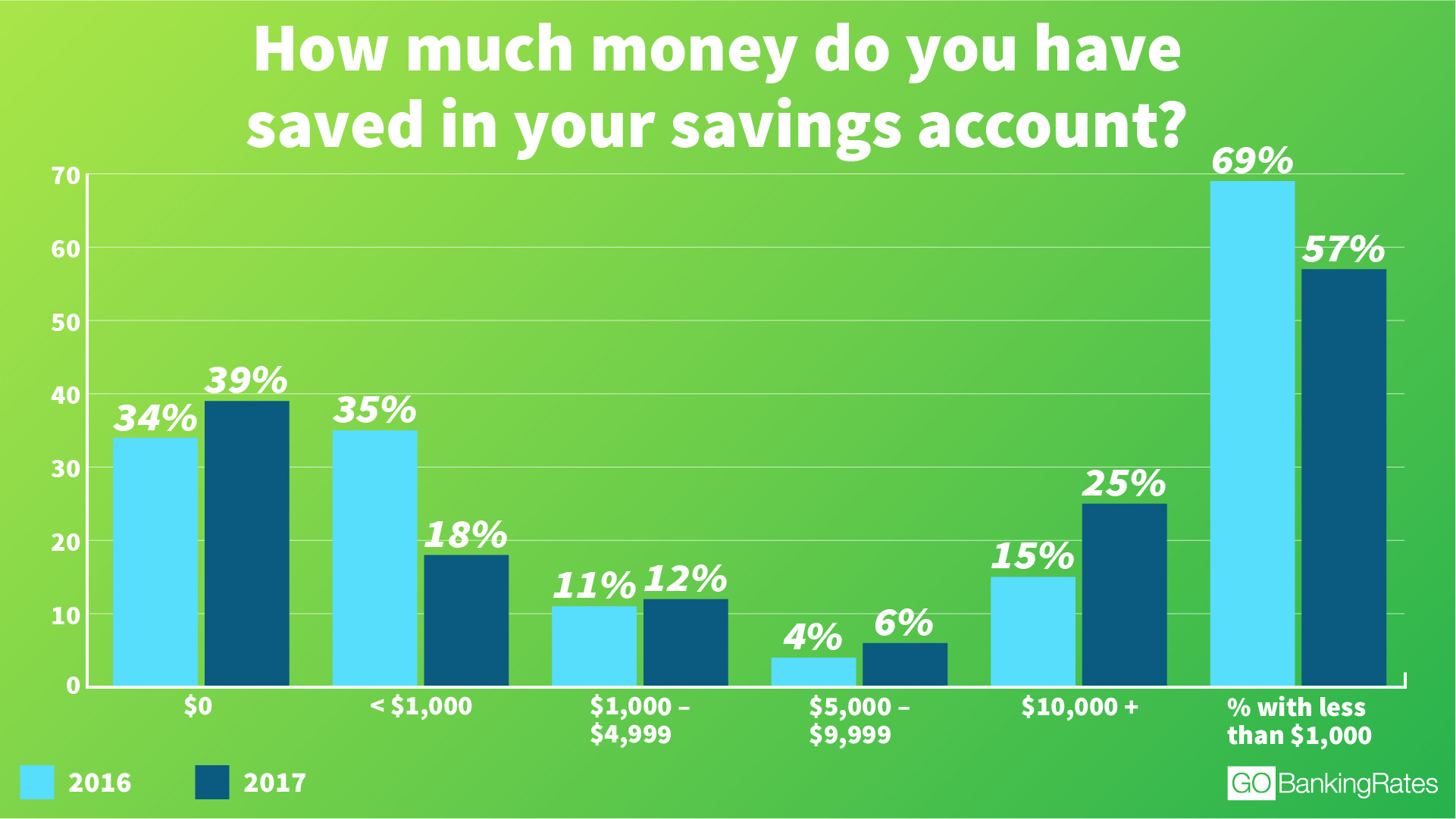
Did you know that 57% of Americans  have less than $1000 in their savings account? Yes, that is right.  I was surprised to read it as well, and infact 39% have no savings at all.

This is based on a 2017 survey by GoBankingRates .

© GOBankingRates - Overall

It doesn't matter how much one earns, what matters most is how much one save.  This is so true!!!

If you are in the 20s and have just began your career, a good rule of thumb is to save atleast 15% of the salary. Once you have an emergency fund that equals to 3-6 months of expenses, one can start contributing to the retirement account. Having an emergency fund, and regular savings starting at young age will go a long way in ensuring one is debt free.

I will write more in the upcoming posts...

Saturday, November 11, 2017

Whats your income?


Do you know how your income ranks to your friends, relatives, neighbors and rest of the US?

http://money.cnn.com/calculator/pf/income-rank/index.html

Some might not be interested in knowing this information, while others like me might be curious to know.

I am fortunate to have a good education and a nice job that puts me > 50%, and am striving to do even better and trying to save as much as possible.
  • Are you in the top 1% or 5%? or 25% or 50%? Where do you stand? 
  • What is your savings strategy?
  • Do you have an emergency fund?
  • Do you save for retirement?
  • What about college savings?
I am sure you have pondered about these questions. If you can comment and let me know your thoughts, I would love to hear about your journey with wealth,

How will the new tax reform affect me?

Yep, that is the question I have been thinking about for the past few days,  and that is probably in everyone's mind.  How will the...